
Paros is one of the most well known islands of the Cyclades, third largest after Naxos and Andros. With a rich history, encapsulated by famous monuments from the lands ancient and medieval past. Picturesque villages, a serene landscape with fertile valleys and rolling hills dotted with small churches and monasteries. Many nice sandy beaches, best of which are located along the southwest side of the island's coast. These are just some of the reasons, coupled with excellent tourist facilities, which has led to Paros being developed into an important centre of tourism in recent years.
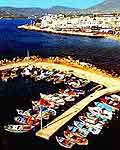 Parikia.
Parikia is the islands capital and port and stands on the site of an ancient
city. During the summer months the population multiplies and it's
character becomes that of a colorful, bustling bazaar. There is a
picturesque and ruinous Venetian castle and the courtyards of the
houses of the town, all of which are painted white, are full of pots
of basil and hung with jasmine and honeysuckle.
A broad paved avenue leads to the church of Ekantondapiliani or Katapoliani, one of the most important Byzantine monuments in the whole of Greece and a place that figures largely in legend. Founded in the 4th century it reached it's present form in the 6th, after various additions were made. On the 15th of August there is a feast day, a great celebration on the sea front with fireworks and songs of the sea.
Also situated in Parikia is the Archaeological Museum of Paros. The museum was founded in 1960, when a large room was built next to the High School, to house the many sculptures and reliefs from all periods of antiquity and made from the famous Parian marble. The antiquities which were until then kept in the cells of the Katapoliani monastery. A second room was built at the end of the 1960's and further extension work of the museum began only recently, in 1995.
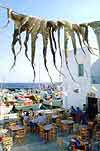 Naoussa.
Naoussa is the renowned harbor of Paros which played an important
role in various periods of the islands history. Today it is one of
the prettiest villages in Cyclades, with white washed houses, narrow
paved alleys, arches and tiny chapels it also offers a range of
excellent beaches and attracts many visitors each summer.
Near to the town of Naoussa is the Palaiopyrgos ("old tower"), with
ruins from the Classical period. According to archaeologists the
capitol of ancient Paros was situated here.
Among the beaches near Naoussa, special mention should be made of Kolibithres, where huge rocks eroded into strange shapes remind the visitors of sculptures embedded in the sand.
 Other areas worth visiting on Paros include the site of
Petaloudes,
an idyllic landscape of dense vegetation and abundant running water.
Thousands of butterflies gather here in the summer months lending a
unique beauty to this serene area of the island.
Other areas worth visiting on Paros include the site of
Petaloudes,
an idyllic landscape of dense vegetation and abundant running water.
Thousands of butterflies gather here in the summer months lending a
unique beauty to this serene area of the island.
Lefkes, in the island's interior is the extremely traditional and charming village, surrounded by vine fields and citrus trees and olive groves along terraced hills. Unlike the rest of the island Lefkes has many green trees and pine forests nearby. The roads are paved in stone and the day to day life in the village has remained untouched by tourism, staying as it always has been, an authentic Greek, Cycladic village.
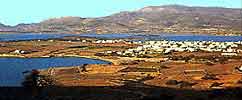 Antiparos and Paros were once joined but are now divided by a narrow
channel. The island is notable for its golden beaches, the
picturesque harbor full of colorful fishing boats and for its
authentic natural beauty. The capital, Antiparos or Kastro, stands
around the original nucleus of the medieval castle.
Antiparos and Paros were once joined but are now divided by a narrow
channel. The island is notable for its golden beaches, the
picturesque harbor full of colorful fishing boats and for its
authentic natural beauty. The capital, Antiparos or Kastro, stands
around the original nucleus of the medieval castle.
The principal attraction of Antiparos is the amazing cave of stalactites on Agios Ioannis hill. There is a chapel dedicated to St. John of the Cave at the mouth of the cavern.
Antiparos has a number of beaches with golden sand and blue-green water. Every year, more and more visitors come to Antiparos, and as a result the hotels and limited number of rooms to rent have difficulty in meeting demand at peak periods.
All around Antiparos are scores of tiny islands, inhabited only by wild rabbits and pigeons. Archaeologists have investigated two of these small islands, Despotiko, produced traces of tombs of the Early Cycladic period, and in 1964 on Saliangos, the ruins of a Neolithic settlement dating back to 4000 BC was discovered.
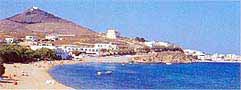 Beaches.
Paros is full of lovely beaches, some busy and others deserted,
stretching along it's entire coastline. Most of the large beaches
have sea sports and are considered some of the finest in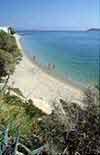 the
Mediterranean.
the
Mediterranean.
Around Parikia the notable beaches are Livadia, Krios, and Agios Fokas. Close to Naoussa are the beaches of Mikro Piperi and Megalo Piperi, Limnes, and Kolimbithres On the eastern side of the island you will find the splendid beaches of Santa Maria, Ambelas, Pisso Livadi, and Drios.
Possible activities in Paros
- Day trips to the islands of Antiparos and Naxos
- Excursion to the Butterfly Valley in the island's interior
- Horseback riding
- SCUBA from Pounda beach and Santa Maria beach
- Boat trips to the island's fabulous beaches
- Windsurfing and sailing
- Swim at the geologically interesting and beautiful beach of Kolimbithres
- Explore the medieval harbor village of Naoussa
- Visit the charming and traditional agricultural village of Lefkes