
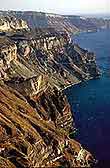
 The fame of the Santorini Caldera View is based on the 85 meter (300
feet) high cliff that many of the island's villages are built to
perch on top of, offering a sea view as far as the eye can see. The
cliff is the wall of the submerged volcano crater caused by the
cataclysmic eruption of this volcano around 3000 BC. In addition to
creating the best views of the Aegean Sea for present day visitors
to enjoy, this eruption also caused the demise of the Minoan
civilization.
The fame of the Santorini Caldera View is based on the 85 meter (300
feet) high cliff that many of the island's villages are built to
perch on top of, offering a sea view as far as the eye can see. The
cliff is the wall of the submerged volcano crater caused by the
cataclysmic eruption of this volcano around 3000 BC. In addition to
creating the best views of the Aegean Sea for present day visitors
to enjoy, this eruption also caused the demise of the Minoan
civilization.
Steeped in history, Santorini has plenty of archaeological sites to visit including the ruins of Ancient Thira,
Akrotiri and the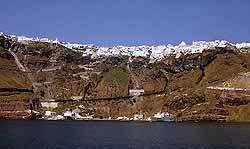 Venetian fortress at Pirgos.
Santorini also offers unique accommodation, inspired by the distinct Santorinian-style, and on the south side of the island there are beautiful beaches with many beach sports and activities available. On the highest peak of Santorini is a monastery of the Prophet Elijah (Profitis Ilias), where there is a picturesque religious feast on 20 July each year.
Fira:
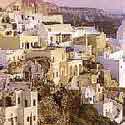 Straddling the edge of the Caldera lies the town of Fira, the capitol of
Santorini. Fira is very attractive, with winding narrow streets, stepped,
white-washed houses, ancient marketplaces, picturesque churches, arcades
and a quarter where the Catholic
Straddling the edge of the Caldera lies the town of Fira, the capitol of
Santorini. Fira is very attractive, with winding narrow streets, stepped,
white-washed houses, ancient marketplaces, picturesque churches, arcades
and a quarter where the Catholic
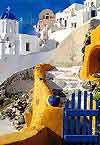 nobility once dwelt. There is a most important Museum, with prehistoric finds
(mostly pottery), a large collection of vases dating from the 7th and 6th
centuries BC (including the pieces known as 'Thera ware'), a few Archaic and
Classical pieces, and some Hellenistic and Roman sculptures and portraits.
There is a superb view out from Fira to the Kamenes, the two islets of black
stone created by the volcano.
nobility once dwelt. There is a most important Museum, with prehistoric finds
(mostly pottery), a large collection of vases dating from the 7th and 6th
centuries BC (including the pieces known as 'Thera ware'), a few Archaic and
Classical pieces, and some Hellenistic and Roman sculptures and portraits.
There is a superb view out from Fira to the Kamenes, the two islets of black
stone created by the volcano.
Oia:
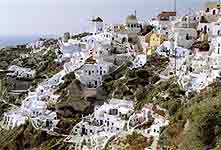 Oia is probably the most charming and well preserved of all of the Santorini
villages, and it's located along the caldera edge, 12 km from the main
town of Fira. The sunsets here are the island's most famous, and there
are plenty of fine dining restaurants from which to relax as you watch the
setting of the sun. Oia is home to artists and writers from around the
world, who are drawn to its aura of serenity and beauty you will therefore
find countless art galleries offering the creations of its inspired
inhabitants. A visit to Santorini would not be complete without a visit to Oia.
Oia is probably the most charming and well preserved of all of the Santorini
villages, and it's located along the caldera edge, 12 km from the main
town of Fira. The sunsets here are the island's most famous, and there
are plenty of fine dining restaurants from which to relax as you watch the
setting of the sun. Oia is home to artists and writers from around the
world, who are drawn to its aura of serenity and beauty you will therefore
find countless art galleries offering the creations of its inspired
inhabitants. A visit to Santorini would not be complete without a visit to Oia.
Perissa:
This resort is one of the most beautiful areas of Santorini. Perissa is very similar to
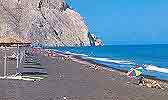 Kamari with its black sand beach and many organized water sports. There are plenty
of tavernas, cafes and hotels in the area set in the wonderful surroundings of Eucalyptus
groves. You will also find launderettes, bakeries and mini-markets. It is separated from
Kamari by Mesa Vouno on which stood Ancient Thira the post eruption settlement.
Kamari with its black sand beach and many organized water sports. There are plenty
of tavernas, cafes and hotels in the area set in the wonderful surroundings of Eucalyptus
groves. You will also find launderettes, bakeries and mini-markets. It is separated from
Kamari by Mesa Vouno on which stood Ancient Thira the post eruption settlement.
Pirgos - The village of Pirgos is built around an old castella (Venetian fortress) and is a typical example of a fortified Cycladic village. Pirgos is one of the largest villages on Santorini, and being built on a hill it offers panoramic views towards all points of the island. At the top of the hill is the monastery of Profitis Ilias with it's impressive iconostasis. You will also find here a museum housing rare manuscripts and books.
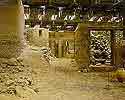 Akrotiri - Is one of the most important prehistoric settlements of the
Aegean. Ruins of a whole Minoan city were found which had been destroyed
around the year 1500 B.C. by an eruption of the volcano of Thera. It is a
case of a prehistoric Pompeii buried under the lava with two and three storey buildings,
city squares, shops and workshops.
Akrotiri - Is one of the most important prehistoric settlements of the
Aegean. Ruins of a whole Minoan city were found which had been destroyed
around the year 1500 B.C. by an eruption of the volcano of Thera. It is a
case of a prehistoric Pompeii buried under the lava with two and three storey buildings,
city squares, shops and workshops.
Ancient Thira - Ancient Thira was found at Mesa Vouno, about 15km
(9½ miles) south-east of today's capital. Its settlements date from the ninth century BC, and
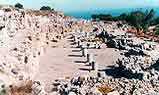 the preserved ruins belong to the Hellenistic and Roman phases of the city.
One of the most important monuments of the site is The Sanctuary
of Artemidoros, entirely hewn in the rock, as well as the Agora (market),
several temples to Dionysius and Apollo, a theatre, the garrison's drill-ground,
the gymnasium and the Roman baths. Some of the many items that
have been found here are on display in the Archaeological Museum in Thira.
the preserved ruins belong to the Hellenistic and Roman phases of the city.
One of the most important monuments of the site is The Sanctuary
of Artemidoros, entirely hewn in the rock, as well as the Agora (market),
several temples to Dionysius and Apollo, a theatre, the garrison's drill-ground,
the gymnasium and the Roman baths. Some of the many items that
have been found here are on display in the Archaeological Museum in Thira.
- Sailing excursions to the Volcano island which is a semi active crater with smoke that comes from the ground
- Sunset sailing excursions around the island to see the caldera face from the vantage point of the sea
- SCUBA and beach sports in Perissa
- Romantic meals in the charming village of Oia watching the sunset
-
The Nautical Museum in Oia, with rare marine items, models of old and
 new ships and library
- A visit to the Minoan village of Akrotiri which was destroyed but preserved similarly to Pompeii when the Santorini volcano erupted
- The New Museum of Fira, which opened in March 2000, is the second largest pre-historical museum in Greece. It exhibits frescoes from Akrotiri and the first golden find in Cyclades
- The Old Historical Museum in Fira, with finds from Santorini and the Greek Hellenic Period
- Boutaris Winemakers, in Megalohori. Excellent decoration, wine tasting and multimedia history of the island
- Megaron Gyzi in Fira, with old clothes, maps and cards from Santorini before the earthquake in 1956
Transfer Info:
During the summer months in Santorini there are an average of 60,000
tourists on the island per day. On the entire island there are only 32
taxis, which means that depending on taxis for transport can be an
exercise of great patience. For this reason I highly recommend that for
your arrival at least you arrange for a transfer, which entails being met
at the port by a person holding a sign with your name on it, who will then
transport you to your accommodation. Since there are no street names or
building numbers for addresses in Santorini this also is extremely helpful
because you will be shown to your lodging.